Services
Detailed information
The links on the home-page cards bring you here. Below you will find more information about each service. Prices are available in the Prices section on the home page .
Ear piercing
For children and adults, boys and girls, using Studex's excellent instruments and quality piercing earrings. I look forward to welcoming you to my Budapest or Székesfehérvár salon. For children, I use only the Studex System 75; I do not use the Universal system during childhood.
The ear-piercing procedure
For a child's ear-piercing appointment, choose a time when they will not be hungry, tired or unwell. Avoiding distractions makes the experience calmer and more comfortable for every age group.
Once the piercing earrings have been chosen, I disinfect the earlobe and use a marking pen to plan their position. With babies and young children, I always use distraction during this step and never restrict their freedom of movement. After disinfection and marking, the earrings are inserted while the child sits on their parent's lap.
Ear piercing involves minimal discomfort, especially with the Studex System 75, which inserts the earring gently and silently. For this reason, it is the only system I use for young children. Children generally settle quickly afterwards: older children are reassured by seeing their earrings, while babies find comfort in a bottle, a toy or breastfeeding.
I am often asked whether ear piercing hurts and whether I use an anaesthetic. There is a little pain at the moment of piercing. No ear piercing is completely painless, but the discomfort is limited to that moment. I do not use anaesthetics because I cannot know which products a client may be allergic to, and the salon is not equipped to treat an allergic reaction to an anaesthetic. Afterwards, I explain aftercare in detail and demonstrate it in practice.
About the ear-piercing systems
I always use modern Studex piercing instruments with compatible, sterile piercing earrings made from nickel-free surgical metal, titanium or 14-carat gold. I do not pierce with previously purchased earrings brought by clients, as these cannot be fitted into the instrument.
Studex System 75
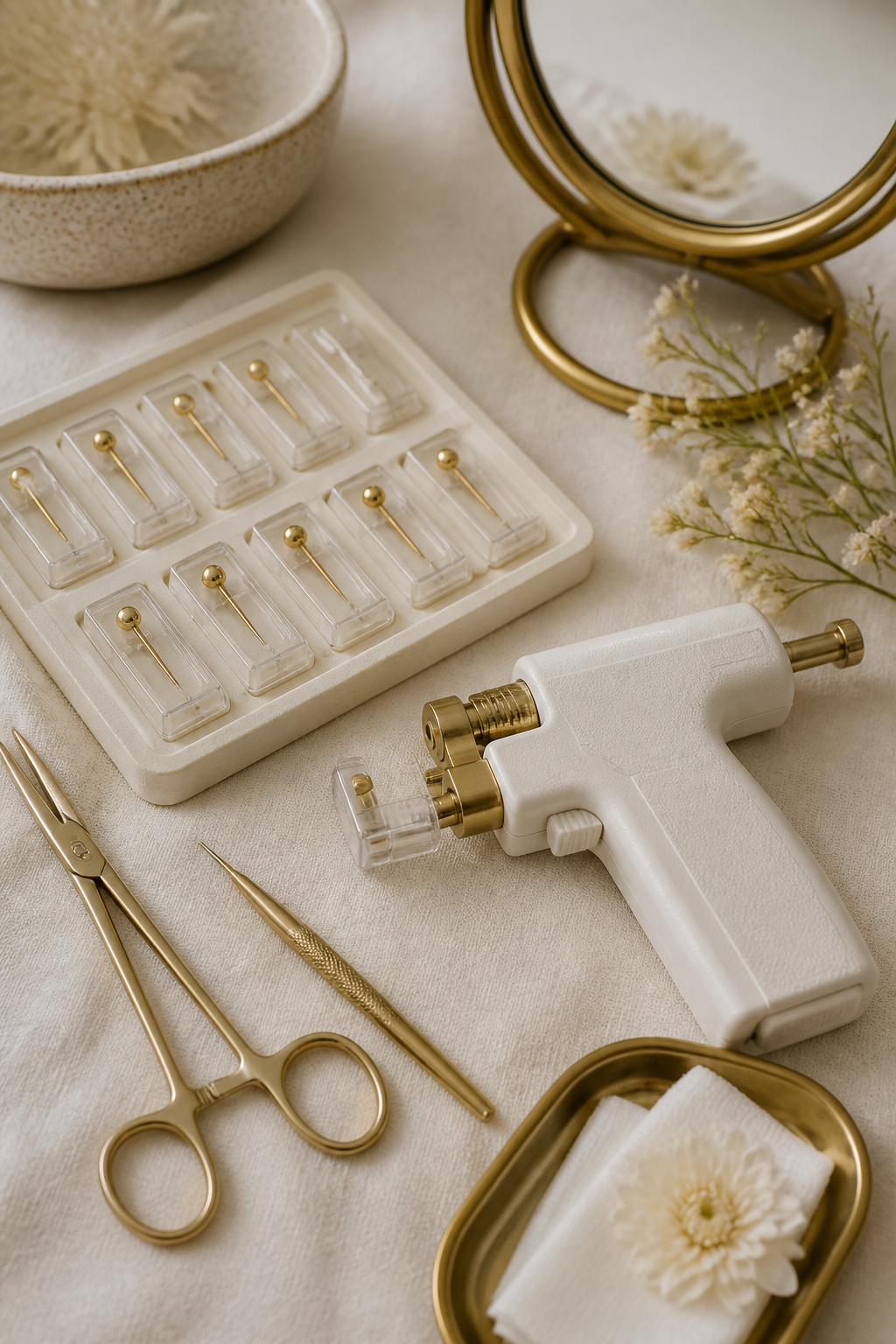
The Studex System 75 is a state-of-the-art instrument. It is silent and not spring-loaded, making piercing gentle with minimal discomfort. Its single-use cartridge system ensures hygiene: the instrument does not touch another person's ear, and the empty cartridge is discarded after piercing. The available earrings have thinner posts and come in more modern designs. This is the method I recommend for babies and young children.
Studex Universal
The Studex Universal is an older design: reliable and accurate, but with fewer advantages than the System 75. A spring mechanism shoots the sterile earring into the earlobe, making the procedure louder and more uncomfortable. Classic sterile piercing earrings made from nickel-free surgical metal are available for this system. I do not use it for babies or younger children. I also do not insert or pierce with earrings brought by clients.
Studex experience package – HUF 25,000
The package includes:
- A gift voucher for Studex System 75 ear piercing, with almost 200 different earring designs to choose from
- Studex Sensitive nickel-free surgical-metal earrings, which can be used as replacement earrings after one month
- An aftercare product for fast, trouble-free healing
- An extra pair of nickel-free surgical-metal earring backs
Both ears at once or one at a time?
For a beautiful, symmetrical, high-quality result, the two earlobes should never be pierced simultaneously: two practitioners cannot insert the earrings at exactly the same time, parallel to each other and aligned with the face. Allow a comfortable maximum of 30–40 minutes for your visit to the salon.
Studex Baby Box
HUF 25,000
Studex's new Baby Box range offers much more than a pair of piercing earrings.
The Baby Box includes:
- A pair of sterile, short-post earrings made from nickel-free surgical metal
- A disinfecting wipe
- A keepsake box with a photo holder
- Aftercare solution
- A pair of earring backs
The keepsake box can also hold a baby's first lost tooth and first lock of hair. If you are interested in the Baby Box, please contact me. I will be happy to explain the options and prices.

Piercing earrings
Browse the categories below to see our in-stock, sterile-packaged piercing earrings. Choose from nickel-free surgical metal, 14-carat gold and titanium jewellery, available immediately without pre-ordering. Occasionally, individual designs may be temporarily out of stock.
- Nickel-free surgical-metal piercing earrings
- Baby Box piercing earrings
- 14-carat gold piercing earrings
- Titanium piercing earrings
I carry out ear piercing only with compatible piercing earrings supplied in sterile capsules. I do not insert earrings brought by clients, particularly for children.
Aftercare
Proper aftercare is very important for fast, trouble-free healing after ear piercing.
The three most important rules
- Keep the jewellery clean – cleaning your jewellery matters both during healing and afterwards.
- Apply drops or spray – aftercare products help maintain hygiene during healing and afterwards.
- Keep the earring back loose – avoid painful inflammation: never press the earring back tightly against your earlobe.
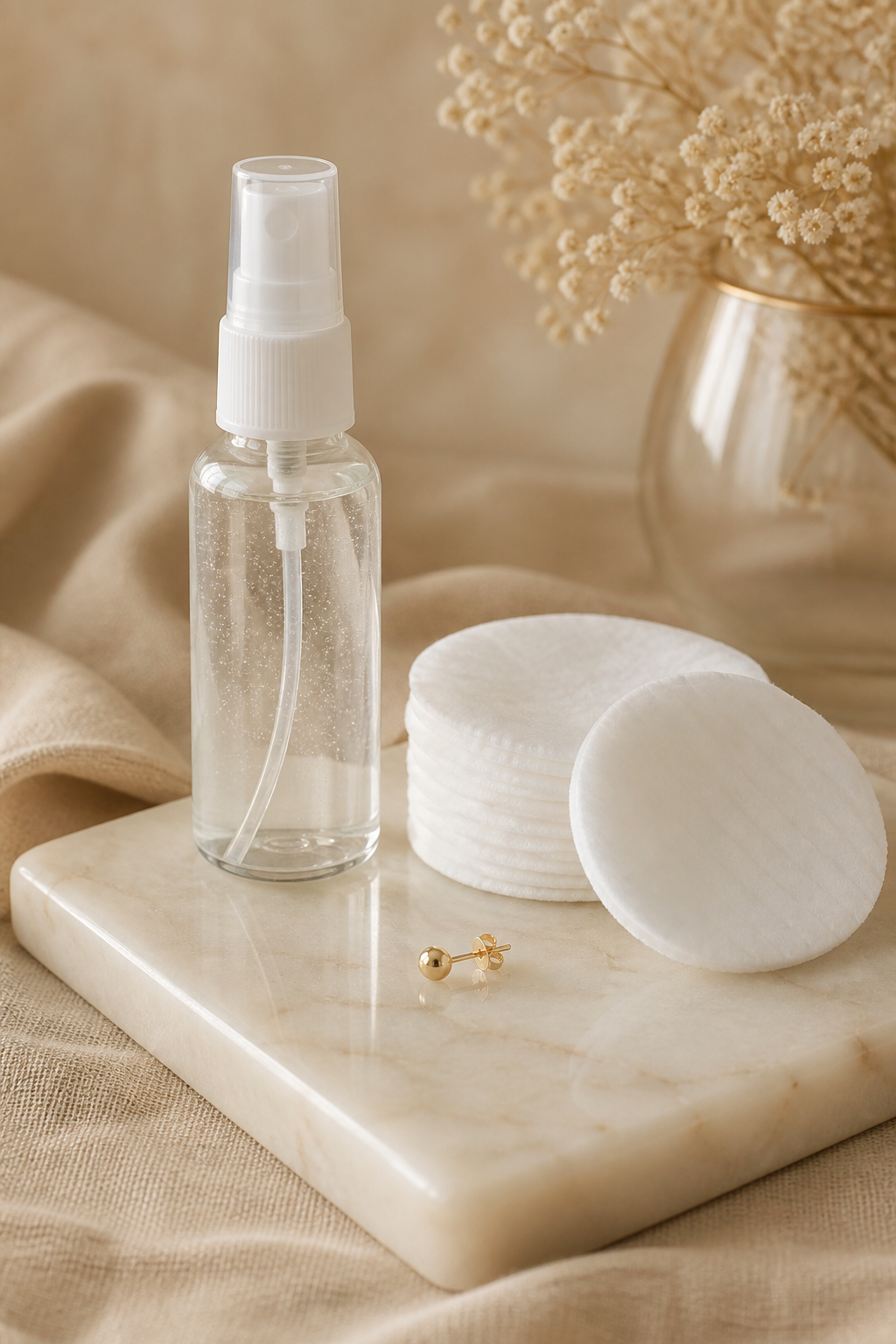
Aftercare products
There are two aftercare products to choose from:
- Standard aftercare solution – HUF 2,000 (7 ml) – apply drops around the piercing.
- Advanced 2-in-1 formula – HUF 6,000 (100 ml spray) – a hypochlorous-acid-based product with excellent cleansing properties, a skin-neutral pH and high skin compatibility. Dermatologically tested, for faster recovery and fewer complications.
Aftercare steps
- Do not remove the piercing earrings from your earlobes for six weeks.
- For two weeks, treat the area around the piercing twice daily, front and back, with the recommended aftercare product.
- After applying the product, gently move or rotate the earring in the earlobe.
- Make sure the earring back is not pressed tightly against the earlobe.
- Once a week, clean beneath the earring back with a damp cotton bud.
- Your ears may come into contact with water after piercing: washing your hair, bathing and swimming are not a problem.
- You can change the earrings after six weeks. If replacement jewellery is not inserted immediately, the piercing may close up easily.
- Regular cleaning and a loose earring back are the basis of comfortable long-term wear.
The first month's aftercare in more detail
Once a week, use a folded damp wipe (not an alcohol wipe) to clean thoroughly around the piercing holes. Slide the jewellery forwards towards the face and then backwards towards the back of the head, cleaning the area beneath the earring back. This is necessary because a build-up of shampoo, dirt, sweat and other residue can cause inflammation. Continue regular cleaning after the piercing has healed.
Morning and evening, slide the jewellery forwards and backwards as you do when cleaning, and treat both the entry and exit holes. Continue this daily until the solution runs out. It is advisable to rotate the earrings gently in both directions once or twice a day, always with clean hands.
To avoid inflammation, the earring back must never be tight. There is a notch on the post, indicated by a click: never push the back beyond it. Check once or twice a week that it has not been pushed tighter in the meantime.
Changing your piercing earrings for the first time
After one month, or the recommended six weeks, the earrings can be changed. Put a drop of oil on the earlobe around the piercing, then remove the earring by firmly pulling the front and back in opposite directions. Oil the replacement earring's post too, then insert it gently. A small amount of any clean oil, including cooking oil, may be used. I am happy to help with the change if needed. Changing jewellery purchased at the salon or ordered from the Csakfülbevalók online shop is free; for earrings bought elsewhere, the charge is HUF 2,000 per earring.
If a problem occurs
If the earlobe has discharge or looks red or swollen, it needs treatment for a few days. Do not remove the earrings even if there is a problem: treatment should be carried out with the jewellery in place, otherwise the piercing will close. I recommend a topical anti-inflammatory product, such as Tetran. Use a toothpick to apply a small amount of cream to the affected area beneath the earring on both sides, several times a day if necessary while the problem persists. Once the inflammation has resolved, remove the earring, clean it thoroughly and continue keeping it clean and the back loose. If symptoms persist, it may be worth switching to gold or silver jewellery.
If you notice a problem or an unusual change, I am happy to help — book an appointment to visit in person, or contact me by telephone or email: 06 30 478 0095, fullyukasztas@gmail.com.
Ear piercings and curated ear styling
Forward helix, helix, rook, tragus, conch, orbital, industrial, flat and daith ear piercings in Budapest and Székesfehérvár. Price: HUF 10,000–25,000 each, depending on the design, including jewellery and the service fee. I do not offer septum piercings.
I perform ear piercings with a sterile cannula needle, using metal, steel, titanium, silver or 14-carat gold jewellery available at the salon. Ear piercing with sterile-packaged, nickel-free surgical-metal piercing earrings is also available. I always disinfect the area and mark my suggested position, then agree the final placement with the client before piercing. The service concludes with detailed aftercare advice.
I offer helix, forward helix, conch, orbital, tragus, anti-tragus, vertical tragus, flat, rook and lobe piercings, as well as migraine and stress piercings. Please note that a daith piercing and a migraine piercing are placed in the same fold of cartilage: they are the same piercing.
I am happy to help with the insertion of almost any type of jewellery. For more unusual ideas, please discuss them with me by email before booking: fullyukasztas@gmail.com.
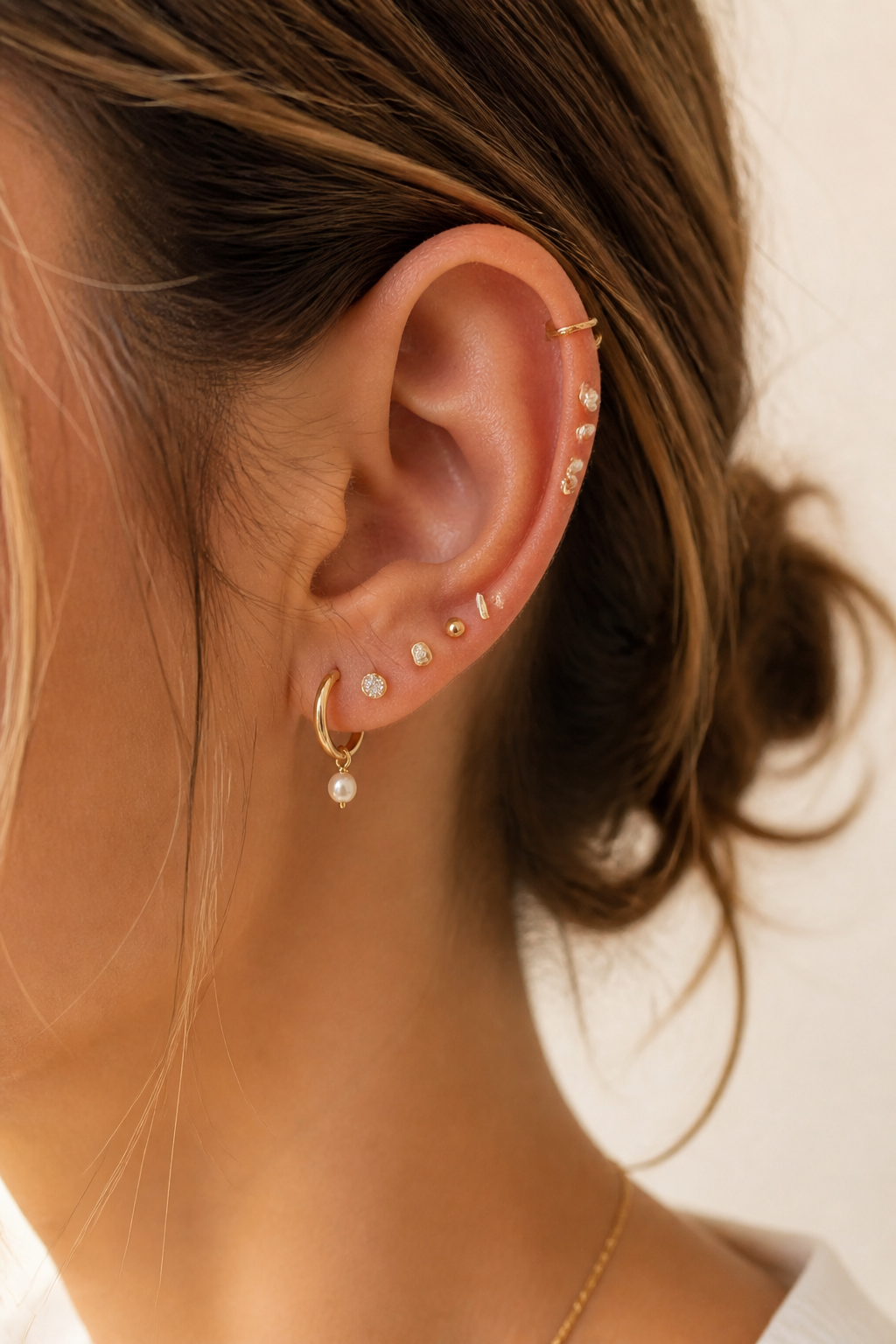
Medisept nose piercing
Medisept specialist nose-piercing salons in Székesfehérvár and Budapest. Service price: HUF 17,000.
I have many years of experience inserting nose piercings using Medisept's professional instruments and high-quality titanium jewellery.
About instrument-assisted nose piercing
Unlike traditional nose piercing with a needle or cannula, this method uses a dedicated nose-piercing instrument to insert the jewellery into the nostril, in a similar way to ear piercing.
Piercing with the Medisept instrument has three advantages over traditional needle piercing:
- Less painful – the instrument places the jewellery immediately after making the piercing, with no additional step required.
- Faster – the nostril is pierced in a single movement.
- More hygienic – the practitioner does not touch the nose jewellery, which is supplied in a single-use sterile capsule.
The available nose jewellery is made from titanium and contains no nickel, so with appropriate aftercare it does not cause an allergic reaction after insertion.
Unfortunately, I cannot use this technique with nose jewellery brought by clients. The instrument requires titanium jewellery supplied in a sterile capsule. Jewellery brought from elsewhere is not compatible with it.
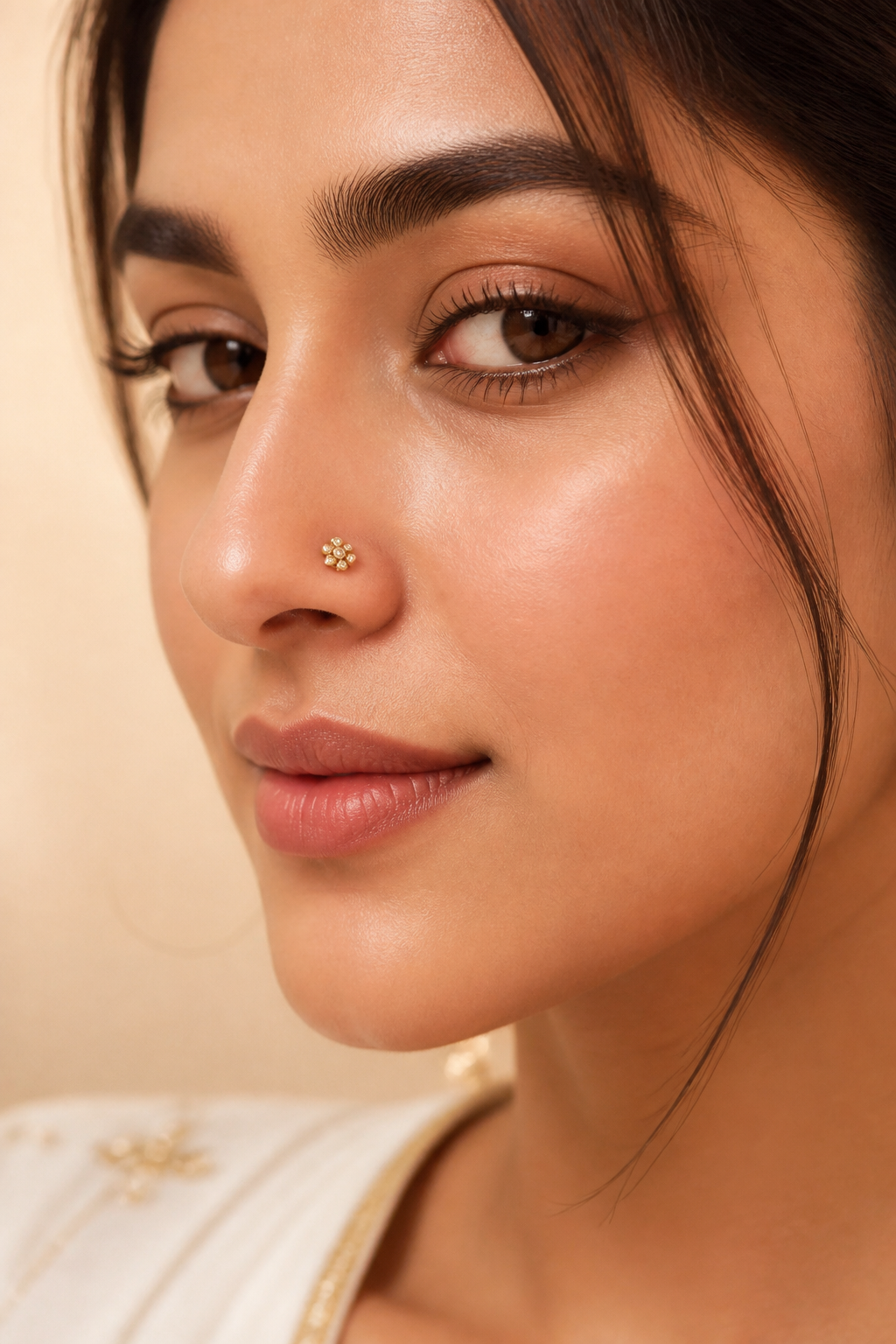
The piercing procedure
First, I disinfect the skin of the nostril and mark the position after a short consultation. The instrument then inserts the selected sterile titanium nose jewellery in a moment.
Aftercare following nose piercing
Clean the nose piercing inside and outside every morning and evening with a damp cotton bud, as accumulated residue can cause inflammation. During cleaning, gently move or rotate the jewellery a little to prevent it from drying into the piercing. Always carry out aftercare with clean hands and in hygienic conditions.
I usually recommend daily use of after-piercing gel, which is included in the service price. Apply a small amount to the nostril around the hole and beneath the jewellery. I do not recommend chamomile or alcohol, as they dry out the skin. Do not remove the inserted nose jewellery during the first month.
After one month, the nose jewellery can be changed. Apply oil or a rich cream to the nostril, firmly pull out the original jewellery, oil the post of the replacement piece and insert it. Changing jewellery bought at the salon is free; for jewellery bought elsewhere, the charge is HUF 2,000 per piece. A nose piercing can close very quickly without jewellery, so do not leave it empty for long.
If you experience inflammation, excess tissue growth or a keloid, please contact me so I can help. Aftercare is free for my own clients; the fee for piercings performed elsewhere is HUF 5,000.
Migraine piercing
What is a migraine piercing?
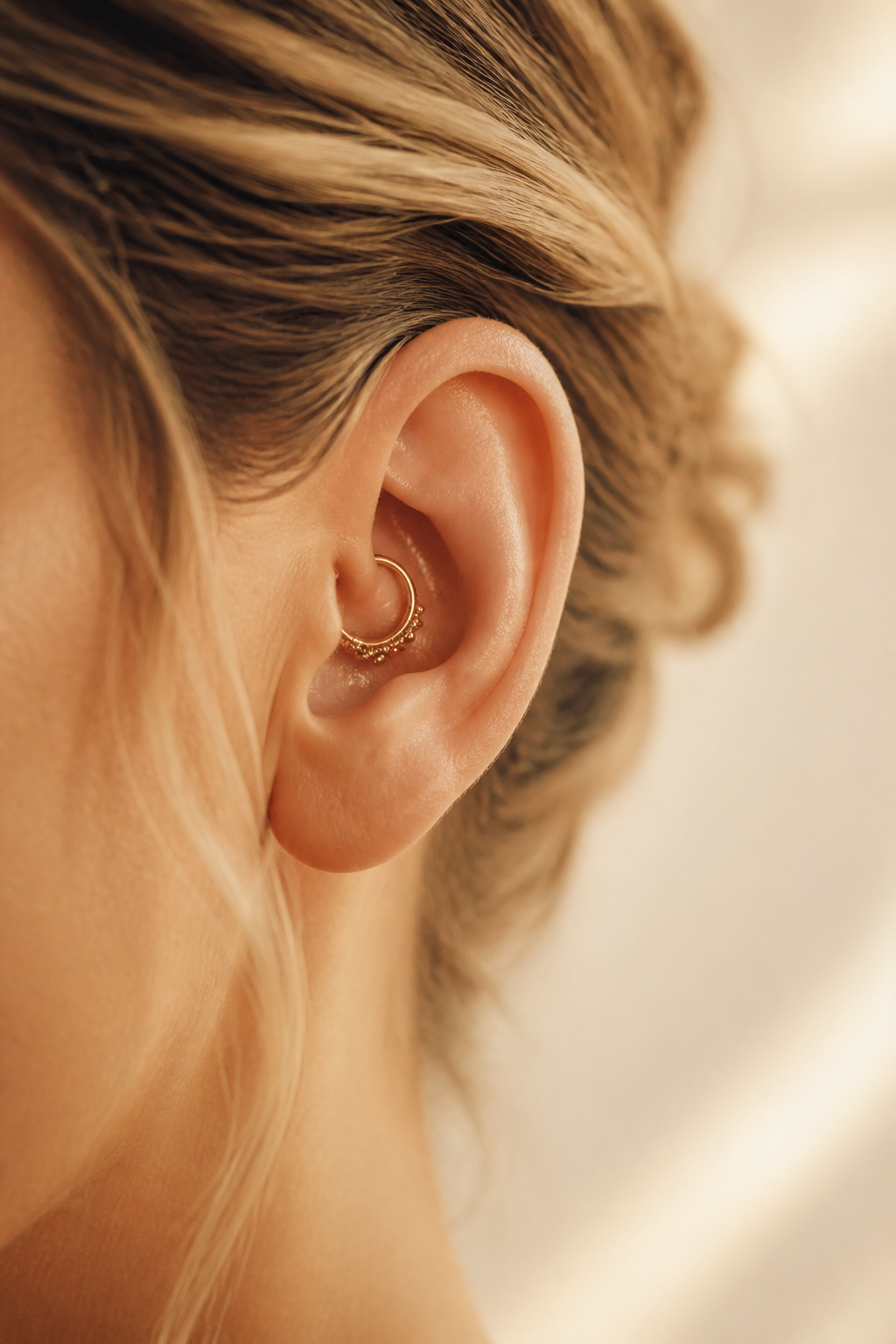
A migraine piercing is jewellery placed in the fold of cartilage above the ear canal. It is primarily cosmetic, but it may have pain-relieving, antispasmodic or wellbeing benefits; results cannot be guaranteed. I use a device to identify the precise piercing position.
Please note that this service is not acupuncture or medical treatment, and the jewellery is not a medical device. Available styles include hoops, horseshoes and curved barbells.
A migraine piercing is placed at the same point as a daith piercing: the two names refer to the same type of piercing. I am also happy to perform it for purely aesthetic reasons, without any expectation of wellbeing benefits.
Migraine is a neurological condition that may involve severe headache, cramping head pain, nausea, vomiting and sensitivity to light and sound, sometimes lasting several days. There is currently no scientifically established evidence that piercing is effective in treating or preventing migraine. Reported experiences are mainly based on client feedback; many clients describe milder or less frequent symptoms.
This is a small, curved fold of cartilage, so piercing it requires skill and considerable precision. It is best entrusted to an experienced practitioner.
Client feedback
According to client feedback, people with migraine piercings report less frequent, milder or shorter-lasting headaches and migraine symptoms, as well as a reduction in the amount or strength of medication they need.
Sometimes a single piercing does not bring the hoped-for change. If needed, a second, reinforcing piercing can be placed in the opposite ear one month after the first. In that case, only the price of the selected jewellery is payable.
The first piercing is usually placed on the side where headaches occur more often. If there is no clear side, the placement is your choice.
“I visited you in the second week of January. As I suffer quite badly from migraines and am sensitive to changes in the weather, with your help I decided on a daith piercing. … After following all the instructions, my ear is now only slightly sensitive a few weeks on, and I can say that I hardly have headaches. During weather changes, which I used to want to spend in a dark room with migraine pain, … I now only feel a slight headache. I have not regretted doing it at all.”
— R. Hajni
Does a migraine piercing hurt?
Most people experience mild pain or brief discomfort. Emotional state, tension and breathing can affect how pain feels, so I often accompany the procedure with a simple breathing exercise. Discomfort is usually minimal and generally limited to the moment of piercing.
Healing and aftercare
A fresh piercing may come into contact with water. Slight bleeding can occur for a few days. The area may be sensitive to touch for several months; this gradually subsides as the cartilage heals.
Aftercare: clean the jewellery and piercing site with a damp cotton bud. Morning and evening, apply a wound-care spray followed by an over-the-counter anti-inflammatory cream from a pharmacy. Treatment is recommended twice daily for two weeks. The cream should be applied across the entire pierced fold of cartilage.
For a CT scan, MRI, X-ray or surgery, replacing metal jewellery with a plastic piece is recommended. Replacement is free when the plastic jewellery is purchased from us (HUF 4,000 per piece); the fee for jewellery brought by the client is HUF 2,000 per piece. Aftercare is free for my own clients and HUF 5,000 per visit for those whose piercing was performed elsewhere.
Stress piercing
What is a stress piercing, and how might it help?
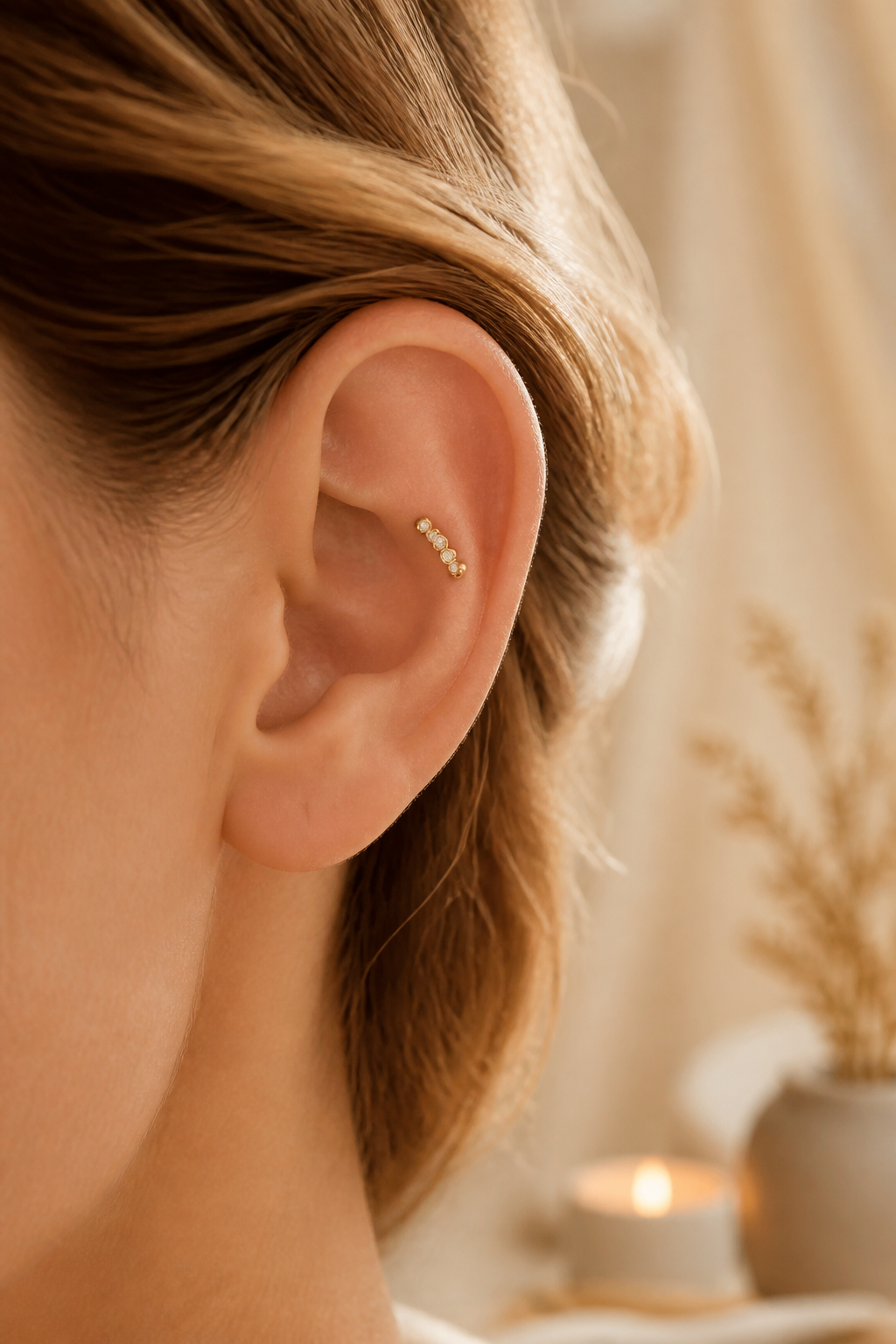
A stress piercing is jewellery placed in the upper central cartilage of the ear. This area contains numerous nerve endings that can be stimulated. The piercing is primarily cosmetic, but it may provide pain relief or wellbeing benefits; results cannot be guaranteed. The service is not acupuncture or medical treatment, and the jewellery is not a medical device.
The vagus nerve plays an important role in regulating the body's resting state. Its activity may decrease under prolonged stress. A stress piercing is thought to be capable of stimulating this area, which is why I use a device to identify the precise piercing position.
According to clients' experiences, a stress piercing may help some people feel less tense and restless, improve wellbeing and have a positive effect on sleep quality, concentration and certain types of pain. Some clients also report an improvement in allergy symptoms.
Client feedback
Client feedback suggests that a stress piercing may ease anxiety and depression, help with sleep and attention difficulties, reduce restlessness, relieve stress and pain, and reduce allergy symptoms.
Sometimes a single piercing does not bring the hoped-for change. If needed, a second, reinforcing piercing can be placed in the opposite ear after one month; in that case, only the selected jewellery is charged. The first piercing is always placed in the ear that experiences less pressure during sleep. If there is no preferred side, the placement is your choice.
I would be delighted to receive a short update on your healing and experience about a month after the piercing. Please email me at fullyukasztas@gmail.com .
Does a stress piercing hurt?
Most people experience mild pain or brief discomfort. I often accompany the procedure with a simple breathing exercise to help you relax. Discomfort is usually minimal and generally limited to the moment of piercing.
Healing and aftercare
A fresh piercing may come into contact with water. Slight bleeding can occur for a few days, and the area may remain sensitive to touch for several months.
Aftercare: clean the area with a damp cotton bud. Morning and evening, apply a wound-care spray followed by an anti-inflammatory cream. Treatment is recommended twice daily for two weeks, and the product should be applied across the entire pierced fold of cartilage.
For medical imaging or surgery, replacing metal jewellery with plastic is recommended. Replacement is free when the plastic jewellery is bought from us at HUF 4,000 per piece; the fee for jewellery brought by the client is HUF 2,000 per piece. If inflammation or excess tissue growth develops, please contact me promptly. Aftercare is free for my own clients and HUF 5,000 per visit for those whose piercing was performed elsewhere.
Piercing correction
Correction of poorly placed ear piercings for children and adults. Clients often ask me to correct an earlier piercing that was placed incorrectly. Correction can be effective if the earring is removed from the misplaced hole as soon as possible and the wound is treated with a skin-healing product, such as Bepanthen, Sudocrem or Neogranormon, to support healing without a scar. A new piercing can be performed as soon as the wound has healed.
I make new piercings to replace torn, stretched or old, poorly positioned holes. These holes generally do not close on their own, but they can be neatly corrected through plastic surgery. Poor placement is often due to lack of experience, failure to mark the position or outdated technique.
The procedure
First, remove the recently inserted earrings and begin treating the wound. If the previous position was right but the piercing was angled, wait until the wound has completely healed, approximately 10–12 days. If the new piercing will be in a completely different position, correction may be carried out immediately. After an in-person consultation, I plan and mark the new position and perform the piercing in the usual way. Correction costs the same as a standard ear piercing, with no extra charge. I use sterile earrings compatible with the instrument; previously inserted earrings cannot be reused.
Gift vouchers
Gift vouchers are available to purchase at our salons.